NextPM
High-performance OEM particle sensor for air-quality monitoring
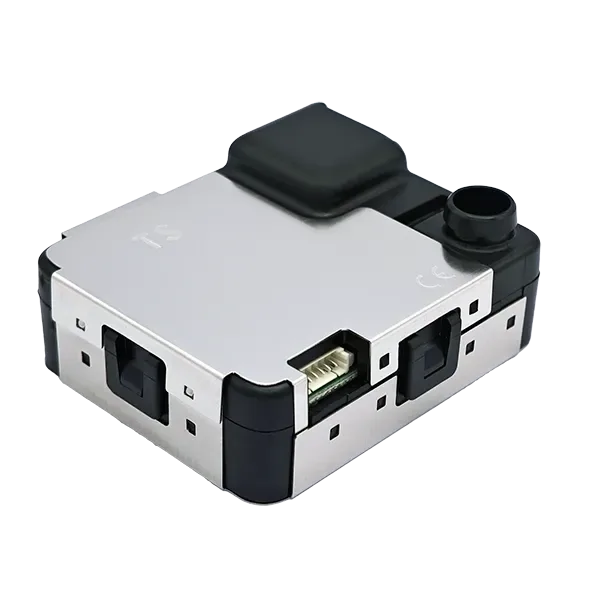
NextPM is a compact OEM optical particle sensor designed for continuous air-quality monitoring. It measures PM₁, PM₂.₅ and PM₁₀ mass concentrations together with particle information across five size channels.
Its active airflow, humidity management, dual-angle optical detection and anti-clogging architecture address several of the limitations commonly encountered with compact optical PM sensors.
NextPM is designed for integration into environmental monitoring stations, HVAC and smart-building systems, industrial equipment and custom scientific instruments.
- PM₁, PM₂.₅ and PM₁₀
- Active humidity management
- Dual-angle optical detection
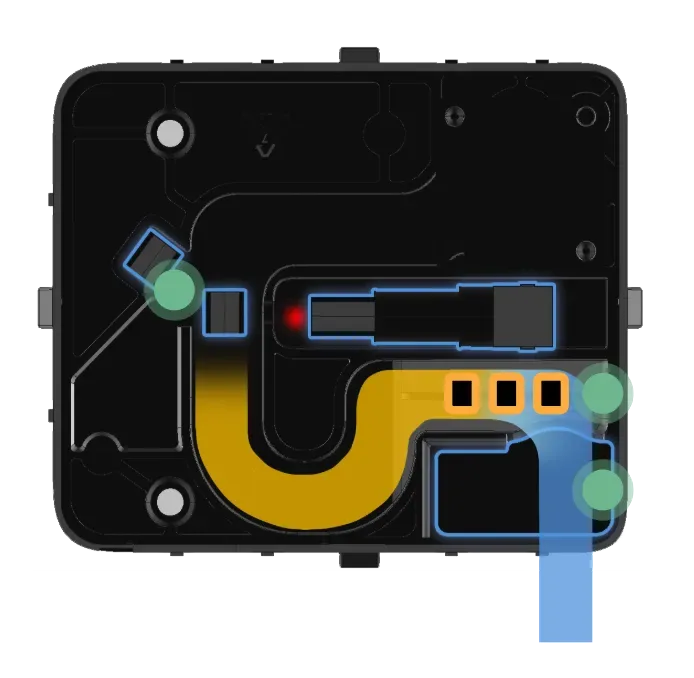
Designed around the known limitations of compact optical PM measurement
Compact optical sensors must operate under changing humidity, aerosol and installation conditions. These factors can affect particle response, airflow stability, contamination and measurement consistency over time.
NextPM combines active environmental management with a patented optical and fluidic architecture designed to provide more reliable particle data across demanding OEM applications.
Active humidity management
The incoming aerosol is thermally managed before optical measurement to reduce the influence of humidity and hygroscopic particle growth.
Dual-angle optical detection
Two optical detection angles provide additional information about particle scattering and support a more stable representation of the measured aerosol.
Active and monitored airflow
Integrated airflow generation and monitoring provide controlled sampling conditions without relying only on uncontrolled natural convection.
Protection against contamination
The internal architecture limits the entry of large particles and reduces contamination risks in long-term monitoring applications.
2026 update
Independent evaluations and published performance data
NextPM has been evaluated in laboratory and field conditions by independent organizations and research teams. The data below summarizes publicly available results for NextPM and selected particulate matter sensors. Test conditions and sources are provided for each dataset.
Results originate from different studies and test conditions and should not be interpreted as a single standardized head-to-head test. Score calculated from published data — methodology available below.
Sources and methodology
Scoring methodology — how each axis is calculated
Scores are derived from the quantitative results published in the cited studies and normalized linearly from 0 to 10 across the tested population. Where no published figure allows a score to be computed for a given sensor on a given criterion, the cell reads N/A: it is excluded from that criterion and from the total, whose maximum is adjusted accordingly — two sensors scored on a different number of criteria therefore have totals that cannot be compared directly. N/A is not a low score — it means the measurement has not been published. The evidence text is kept, because what is known about the sensor keeps its value even without a figure.
PM₂.₅ accuracy : R² values: lab weight 40%, field 60%. Scale: R²=0.50→0, R²=1.00→10.
Humidity resilience : Water aerosol rejection ratio + field RH slope. Active heater = strong advantage. No heater = capped at 4.
Low noise : Clean-air std dev + max outlier [4]. Lower = better. Integer-only output penalized.
Inter-unit consistency : Between-Sensor Uncertainty (BSU) [5]. Scale: BSU=0→10, BSU=4→0.
Coarse fraction : R² for PM₁₀−PM₂.₅ from VITO [5]. Linear: R²=0→0, R²=1→10.
Price (affordability) : Linear inverse: €15→10, €450→0. OEM unit prices.
Size channels / ML : Real channels (50%) + demonstrated discrimination (50%). ML adds to score.
Dynamic response : Inverse of t10-90 [7]. Faster = higher. PMS5003 from datasheet.
Evidence per axis
PM₂.₅ accuracy 9.5 N/A 7.5 N/A 7.5 7
- NextPM 9.5 Lab R²>0.99 vs T640x across 9 T/RH conditions [2]. Field R²=0.88–0.95 (California, 2mo) [1], R²=0.82–0.98 (Marseille, 2mo) [3], R²=0.87 (Antwerp, 3mo) [5]. Lab R²=1.00 VITO chamber (best of all) [5].
- OPC-N3 N/A Insufficient published quantitative data for this sensor on this criterion. Good in high-PM but drops in mild pollution. OPC-N2 R²=0.975 strong pollution, <0.5 mild [4]. Not directly tested vs FEM in NextPM studies.
- SPS30 7.5 Lab R²=0.99 (VITO). PM₂.₅ accuracy 53–56% [5]. R²≥0.97 for multiple aerosol types [11].
- SDS011 N/A Insufficient published quantitative data for this sensor on this criterion. Strong size dependency. 2/5 units malfunctioned during IUTA testing [7].
- OPC-R2 7.5 R²=0.96 lab. Detection efficiency closest to 1 in IUTA study [7].
- PMS5003 7 Lab R²≥0.97 [11]. Field R²=0.78–0.90 [10]. Drops to 0.18–0.72 mild pollution/wildfire [9]. Accuracy 86–93% fine PM, poor >2.5µm [12].
Humidity resilience 9.5 3 N/A 3 N/A 2.5
- NextPM 9.5 Patented internal heating (<60% RH). Water aerosol max PM₁₀=11.3µg/m³ vs 103.3 OPC-N3 (9×) [4]. Field RH slope: 0.10 vs 0.63 (6×) [4]. AQ-SPEC: no climate effect 5–35°C, 15–65% RH [2].
- OPC-N3 3 No heater. Water aerosol max PM₁₀=103.3µg/m³. Field RH slope: 0.63, R²=0.248 [4].
- SPS30 N/A Insufficient published quantitative data for this sensor on this criterion. No heater. PM overestimation at RH>60% [5][13].
- SDS011 3 No heater. Overestimated up to 38× when aerosols not dried [7].
- OPC-R2 N/A Insufficient published quantitative data for this sensor on this criterion. No heater. Similar to OPC-N3 [7].
- PMS5003 2.5 No heater. Accuracy drops >50% RH. Overestimates ~30–40% ambient [10][9]. ±10–15µg/m³ specified accuracy [12].
Low noise 9 4 N/A N/A N/A N/A
- NextPM 9 PM₂.₅=0.3±0.2, PM₁₀=0.5±0.4µg/m³. Max outlier: 2.5µg/m³. Field PM₁₀ σ: 5.6. Score +4/7 criteria [4].
- OPC-N3 4 PM₂.₅=0.4±0.5, PM₁₀=0.6±1.4µg/m³. Max outlier: 17.6µg/m³ (7×). Field PM₁₀ σ: 12.1. Score −4 [4].
- SPS30 N/A Insufficient published quantitative data for this sensor on this criterion. Moderate noise. Better than OPC-N3. Floating-point output [7][11].
- SDS011 N/A Insufficient published quantitative data for this sensor on this criterion. High variability. Variable t10-90 (5–24s). 2/5 malfunctioned [7].
- OPC-R2 N/A Insufficient published quantitative data for this sensor on this criterion. First bin overestimates at low conc. Moderate noise [7].
- PMS5003 N/A Insufficient published quantitative data for this sensor on this criterion. Integer-only (1µg/m³ resolution), spiky, frequent zeros. Less precise than SPS30 [11]. Count data "not reliable" [11].
Inter-unit consistency 10 N/A 7 N/A 5.5 N/A
- NextPM 10 BSU=0.1µg/m³ — lowest of 8 systems [5]. Inter-unit R²>0.99 [3]. CEN: "individual calibration not necessary" [8].
- OPC-N3 N/A Insufficient published quantitative data for this sensor on this criterion. Moderate BSU. Outlier behavior differs between units [4][7].
- SPS30 7 BSU=0.3µg/m³ — 3× higher than NextPM [5]. Good precision Tryner lab [11].
- SDS011 N/A Insufficient published quantitative data for this sensor on this criterion. 2/5 malfunctioned (IUTA). Significant inter-unit variability [7].
- OPC-R2 5.5 BSU=1.6µg/m³ lab [7].
- PMS5003 N/A Insufficient published quantitative data for this sensor on this criterion. Batch R²>0.99 for 8 units. But "less precise than SPS30" [11]. Frequent A/B disagreement in PurpleAir [11].
Coarse fraction 3 1 0.5 N/A 1 0.5
- NextPM 3 R²=0.3 — only sensor with measurable coarse sensitivity. Dual-angle 45°+90° [5].
- OPC-N3 1 R²≈0 despite 24 bins. Truncated viewing angle [5][7].
- SPS30 0.5 R²≈0. Fixed PSD >1µm [5][13].
- SDS011 N/A Insufficient published quantitative data for this sensor on this criterion. Fixed PSD. No coarse differentiation [7].
- OPC-R2 1 R²≈0 despite 16 bins [5][7].
- PMS5003 0.5 Bin 2.5–10µm "noisy and inaccurate" [13]. Misclassifies to smallest bin [9]. PM₁₀ R²=0.34–0.45 [10].
Price (affordability) 9 3 9.5 10 4.5 9.8
- NextPM 9 €69.70 (Standard). Verified €81.70 (+€12), Adjusted €119.70 (+€50) [14].
- OPC-N3 3 €350–450. 5–6× NextPM [7].
- SPS30 9.5 ~€45 [7].
- SDS011 10 ~€30. Cheapest tested [7].
- OPC-R2 4.5 ~€280 [7].
- PMS5003 9.8 €15–25. Most deployed globally (PurpleAir, Airly) [9][10].
Size channels / ML 7 9 4 1 8.5 3
- NextPM 7 5 real channels (0.3–10µm). Fractionation 0.5–5µm better than SPS30 [7]. ML: 82.4% pollutant ID [6].
- OPC-N3 9 24 bins. True spectrometer. Best size resolution [7].
- SPS30 4 5 NC channels. Fixed PSD >1µm. "Overlapping bins = generalized calibration" [13][7].
- SDS011 1 PM₂.₅/PM₁₀ only. No channels [7].
- OPC-R2 8.5 16 bins. Good size distribution reproduction [7].
- PMS5003 3 6 bins but fixed PSD. Count data "remained constant" across all PSL sizes, "not reliable" [11][13][12].
Dynamic response 5 9.5 7 2 9 N/A
- NextPM 5 t10-90=8.1±0.1s. Internal smoothing → smoother signal, slower response [7].
- OPC-N3 9.5 t10-90=1.6s. Fastest tested [7].
- SPS30 7 t10-90=4.6s [7].
- SDS011 2 5–24s variable. Inconsistent [7].
- OPC-R2 9 t10-90=1.8s [7].
- PMS5003 N/A Insufficient published quantitative data for this sensor on this criterion. ~2.3s stable, 200–800ms fast (datasheet). Fast but noisier [9].
Score summary — active sensors
| Axis | NextPM | OPC-N3 | SPS30 | SDS011 | OPC-R2 | PMS5003 |
|---|---|---|---|---|---|---|
| PM₂.₅ accuracy | 9.5 2, 1, 3, 5 | N/A 4 | 7.5 5, 11 | N/A 7 | 7.5 7 | 7 11, 10, 9, 12 |
| Humidity resilience | 9.5 4, 2 | 3 4 | N/A 5, 13 | 3 7 | N/A 7 | 2.5 10, 9, 12 |
| Low noise | 9 4 | 4 4 | N/A 7, 11 | N/A 7 | N/A 7 | N/A 11 |
| Inter-unit consistency | 10 5, 3, 8 | N/A 4, 7 | 7 5, 11 | N/A 7 | 5.5 7 | N/A 11 |
| Coarse fraction | 3 5 | 1 5, 7 | 0.5 5, 13 | N/A 7 | 1 5, 7 | 0.5 13, 9, 10 |
| Price (affordability) | 9 14 | 3 7 | 9.5 7 | 10 7 | 4.5 7 | 9.8 9, 10 |
| Size channels / ML | 7 7, 6 | 9 7 | 4 7, 13 | 1 7 | 8.5 7 | 3 11, 13, 12 |
| Dynamic response | 5 7 | 9.5 7 | 7 7 | 2 7 | 9 7 | N/A 9 |
| Total | 62/80 | 29.5/60 | 35.5/60 | 16/40 | 36/60 | 22.8/50 |
References
Only the references cited by the selected sensors are listed.
- 1 South Coast AQMD (2021). Field Evaluation — Tera Sensor NextPM. AQ-SPEC Program. open source document
- 2 South Coast AQMD (2022). Laboratory Evaluation — Tera Sensor NextPM. AQ-SPEC Program. open source document
- 3 Wortham, H. et al. (2021). In Field Study of NextPM Sensor. Report RR-20210112-01. AtmoSud / LCE, Aix-Marseille University. open source document
- 4 Alvarez Cruz, A., Schalm, O. et al. (2025). Benchmarking Low-Cost PM Sensors. Atmosphere, 16, 172. open source document
- 5 Hofman, J. et al. (2024). Portable Sensors for Dynamic Exposure Assessments. Sensors, 24, 5653. open source document
- 6 Azeraf, E. et al. (2025). Real-Time Pollutant Identification through Optical PM Micro-Sensor. arXiv:2503.10724v1. open source document
- 7 Nothhelfer, M. et al. (2025). Performance Evaluation of 5 Low-Cost PM Sensors for Monodisperse Test Aerosols. Aerosol Air Qual. Res., 25:17. open source document
- 8 Morawska, L., Asbach, C. & Patel, H. (2025). Application of PM₂.₅ LCS for IAQ Compliance Monitoring. Aerosol Sci. Technol., 59(2), 1210–1220. open source document
- 9 Sayahi, T. et al. (2019). Long-term field evaluation of the Plantower PMS low-cost PM sensors. Environ. Pollution, 245, 932–940. open source document
- 10 AQ-SPEC (2016). Field Evaluation — PurpleAir PA-II (Plantower PMS5003). South Coast AQMD. open source document
- 11 Tryner, J. et al. (2020). Laboratory evaluation of low-cost PurpleAir PM monitors and in-field correction using co-located portable filter samplers. Atmospheric Environment, 220, 117067. open source document
- 12 Levy Zamora, M. et al. (2019). Field and Laboratory Evaluations of the Low-Cost Plantower PM Sensor. Environ. Sci. Technol., 53(2), 838–849. open source document
- 13 Kuula, J. et al. (2020). Laboratory evaluation of particle-size selectivity of optical low-cost particulate matter sensors. Atmos. Meas. Tech., 13, 2413-2423. open source document
- 14 TERA Sensor (2026). Product Catalogue. Groupe TERA, Rousset, France. open source document
This comparison compiles data exclusively from independent third-party evaluations. No proprietary data from any sensor manufacturer has been used for scoring. All metrics are traceable to the cited references. March 2026.
Technical specifications
Key optical, environmental, mechanical and integration specifications for the standard NextPM configuration. For controlled sampling, remote sampling or higher concentrations, explore NextPM Advanced.
| Designation | Values | Unit |
|---|---|---|
| GENERAL | ||
| Technology | Optical | |
| Targeted pollutants | Particulate Matter | |
| Outputs | PM₁PM₂.₅PM₁₀TSP ¹˒²Channel: 0.3 - 0.5 μm¹Channel: 0.5 - 1 μm¹Channel: 1 - 2.5 μm¹Channel: 2.5 - 5 μm¹Channel: 5 - 10 μm¹Temperature ³Relative Humidity ³ | μg/m³ & number of particles / Lμg/m³ & number of particles / Lμg/m³ & number of particles / Lμg/m³number of particles / Lnumber of particles / Lnumber of particles / Lnumber of particles / Lnumber of particles / L°C% |
| Airflow | 2.5 | L/min |
| Size (l * w * h) | Annex 1 | mm |
| Lifetime (MTTF) ⁴ | 15 000 | hours |
| PERFORMANCE | ||
| Particle Size detection range | 0.3 - 10 | μm diameter |
| Detection efficiency with 0.3 μm diameter particles | >50 | % |
| Concentration detection range / PM₁₀ - PM₂,₅ - PM₁ | 0 - 1000 | μg/m³ (Arizona dust A1 equivalent) |
| > 1000 ⁵ | μg/m³ (Arizona dust A1 equivalent) | |
| Detection Limit | < 1 | μg/m³ (Arizona dust A1 equivalent) |
| Linearity error | < 5 | % |
| Repeatability error ⁶ | < 3 | % |
| Refresh rate | 1/10/60 | sec. |
| Warm-up time | 10 | sec. |
| Temperature influence | < 0.01 | μg/m³/°C |
| 0°C to 30°C | 0 | %/°C |
| -20°C to 0°C | < + 1.0 | %/°C |
| 30°C to 70°C | < - 0.8 | %/°C |
| ELECTRIC SPECIFICATIONS | ||
| Power supply | 5 | VDC |
| Power consumption in operation | < 70210 | mAmA (Maximum, heater) |
| Power consumption in Sleep Mode | < 20 | mA |
| COMMUNICATION | ||
| UART, Modbus (RS485) ⁷ | ||
| OTHER | ||
| Operating conditions | -20 to +70253 to 343 | °CK |
| 0 - 95 uncondensed | % | |
| 500 to 1 500 | hPa | |
| Storage conditions | -20 to +70 | °C |
| 0 - 95 uncondensed | % | |
| 500 to 1500 | hPa | |
| Certifications | CE | |
| RoHS compliant | ||
| Dimensions and weight | L 62 mm x W 52.5 mm x H 23.6 mm | 45 g | |
| L 2.44 / W 2.05 / H 0.91 inches | 1.59 Oz | ||
- 1 Only available since firmware version 1046 or later.
- 2 Estimated from the other particle fractions and bibliography, validated in the field (available via Modbus only).
- 3 See the NextPM User Guide for more information about these data.
- 4 Lifespan can vary depending on the operating conditions.
- 5 At concentrations above 1000 µg/m³, accuracy decreases due to a higher linearity error.
- 6 Calculated on the fifteen-minute moving average output.
- 7 This communication protocol requires a converter, as described in the "NextPM RS485" document.
Performance values apply under the conditions stated in the corresponding row or in the technical documentation. Optical PM response can vary with aerosol properties and environmental conditions.
Everything needed to integrate NextPM into your product
NextPM is supplied with the technical resources required for mechanical, electronic and software integration. TERA Sensor’s engineering team can also review the intended installation and operating conditions before prototype development.
Performance supported by independent evaluations and published studies
NextPM performance has been assessed through external evaluation programmes and independent scientific studies. These results provide application-specific evidence beyond manufacturer specifications alone.
AQ-SPEC evaluation
South Coast AQMD — independent field and laboratory evaluation program.
PM₂.₅ correlation up to R² = 0.95 and PM₁₀ up to R² = 0.68 against reference-grade instruments, with 100% data recovery over the evaluation period.
View report ↗South Korean Class 1 certification
Korea Conformity Laboratories (KCL) — Certificate of Performance for PM₂.₅ air sensors, No. LS24-00003.
Grade 1 (highest grade), 80.7% accuracy against reference monitoring data, issued under the Special Act on the Reduction and Management of Fine Dust.
View certificate ↓Peer-reviewed publications
4 peer-reviewed studies evaluating NextPM performance.
Topics: benchmarking against reference and low-cost sensors, portable exposure assessment, response to monodisperse aerosols, IAQ compliance monitoring.
View bibliography ↑Field and comparative evaluations
Outdoor and laboratory environments — France (LCE / AtmoSud) and California (South Coast AQMD).
Multi-month field deployments alongside reference-grade instruments, contextualized by aerosol type and test conditions.
View methodology ↑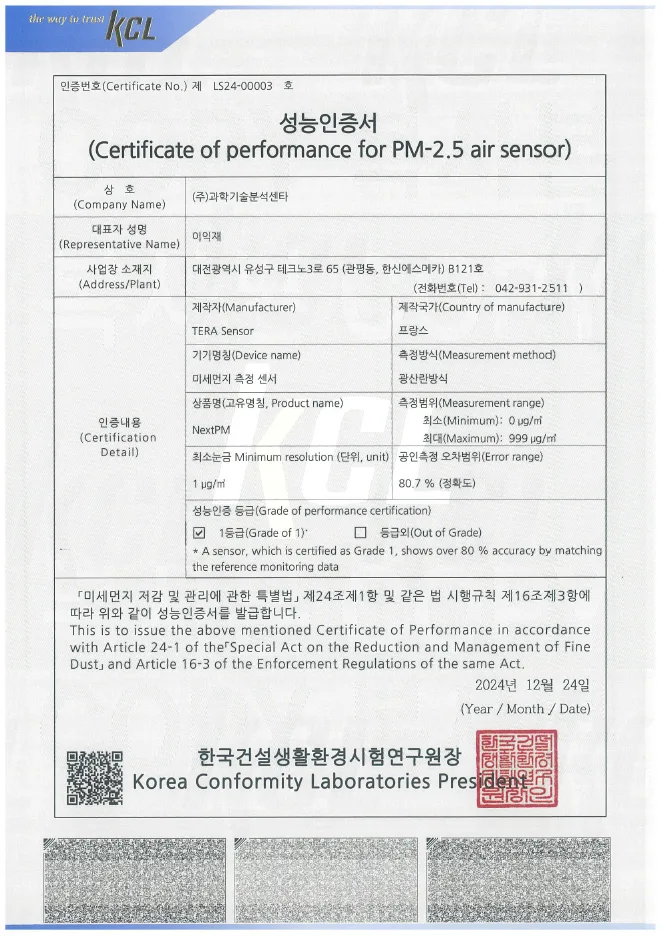
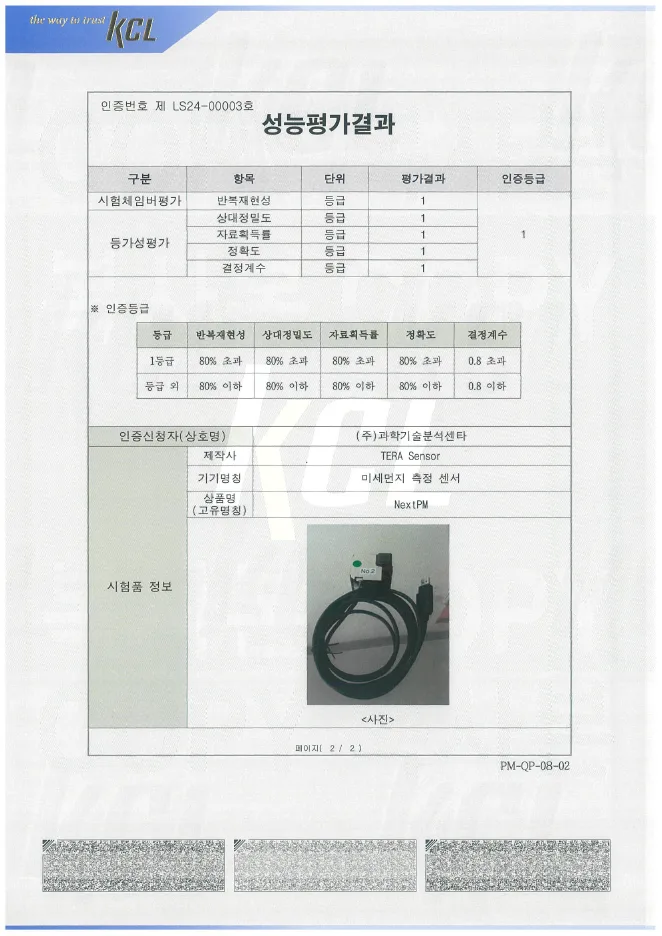
Certificate of Performance No. LS24-00003, issued 24 December 2024 by Korea Conformity Laboratories under Article 24-1 of the Special Act on the Reduction and Management of Fine Dust and Article 16-3 of its Enforcement Regulations.


Integrating NextPM into a new product or monitoring system?
Sensor performance is only one part of the final measurement system. Air inlet design, sensor position, enclosure geometry, thermal conditions, electronics, communication and calibration strategy can all influence the data produced by the final device.
TERA Sensor supports sensor selection, mechanical and electronic integration, firmware, testing and prototype development. Through TERA Tronics, projects can also be supported through industrialization, electronic manufacturing and series production.
- Particle measurement: TERA Sensor.
- Sensor integration: TERA Sensor.
- Electronics and firmware: TERA Sensor.
- Prototype: TERA Sensor + TERA Tronics.
- Industrialization: TERA Tronics.
- Series production: TERA Tronics.
FAQ
NextPM measures PM₁, PM₂.₅ and PM₁₀ mass concentrations and provides particle information across five size channels. It is an optical particle sensor designed for integration into OEM monitoring devices.
NextPM actively manages the incoming aerosol before optical measurement to reduce the influence of humidity and hygroscopic particle growth. Aerosol composition and environmental conditions must nevertheless remain part of data interpretation.
NextPM Standard is the standard production configuration. NextPM Verified includes additional batch-level performance documentation. NextPM Adjusted is individually characterized and adjusted under defined test conditions for applications requiring tighter documented PM₂.₅ performance.
NextPM includes its own airflow architecture for compact OEM integration. NextPM Advanced uses an external pump and controlled sampling architecture for remote sampling, application-specific airflow and higher particle concentrations.
NextPM can be integrated into outdoor monitoring equipment, but it must be protected by an appropriate enclosure and air-inlet design. Water ingress, condensation, solar radiation, temperature and airflow must be considered in the final system.
NextPM can be integrated into HVAC-related equipment when the sampling and pressure conditions remain compatible with its architecture. For direct in-duct monitoring, PMDuct or a controlled-sampling architecture may be more appropriate.
The appropriate verification or adjustment strategy depends on the application, aerosol and expected performance. TERA Sensor can help define a suitable approach for prototype validation and series production.
No. NextPM is an OEM optical particle sensor. Its data can support continuous monitoring and comparative analysis, but the final system and its intended use determine the applicable validation and regulatory requirements.
No. NextPM is not intended for ISO cleanroom classification. SafyrOPC should be used when ISO 21501-4 particle counting is required.
Datasheets, communication documentation, mechanical information, 3D files and integration guidance are available through the technical resources section. TERA Sensor engineers can also support application-specific integration.
NextPM is available for prototype development, pilot production and series manufacturing. Contact TERA Sensor with the expected quantity and project schedule to receive the appropriate commercial proposal.
Yes. For one to a few units needed quickly for a bench test or first evaluation, NextPM is available through authorized distributors. See where to buy NextPM for direct-quotation and distributor options.
Evaluating NextPM for a new product or monitoring system?
Tell us about your application, expected concentration range, operating conditions, integration constraints and production volumes. Our team will help you select the appropriate NextPM configuration.