Technology
The three optical and thermal principles behind NextPM, and the results independent evaluation programmes have measured.
At TERA Sensor, we are committed to advancing air quality measurement through innovation and precision. Our NextPM sensor, designed with over 20 years of expertise in particulate matter monitoring, reports PM₁, PM₂.₅ and PM₁₀ from dual-angle optical counting.
Developed under three patents, this sensor is built for continuous monitoring, in environmental surveillance as well as industrial applications. Stated performance levels apply under the test conditions described in the corresponding documentation: like any optical sensor, its response varies with aerosol properties and operating conditions.
Three patents, three answers
2 detection angles
This feature is unique in this category of optical sensors. Gives a better resolution by the discrimination of particles that could have the same signals at 90°.
Coarse particle trap
Unique feature avoiding the use of an additional physical filter, improving the sensor lifetime by avoiding premature clogging of the flow. Filter blocking particles > 10 µm.
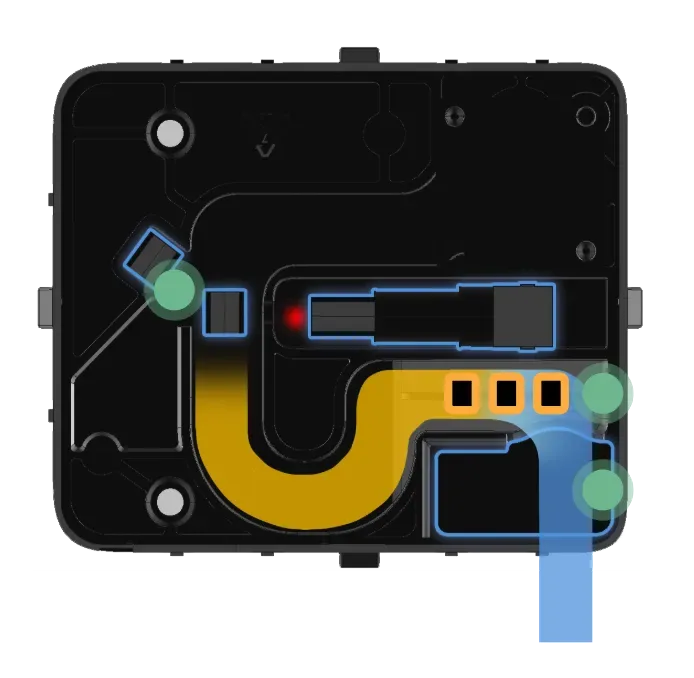
Humidity shield
NextPM heats the sampled flow to bring relative humidity inside the measuring cell below the level at which hygroscopic particles swell and bias optical sizing — the “growth factor” effect. The optical chamber is thermally decoupled from the heated flow, so the humidity correction does not itself shift the measurement. This principle is covered by one of the sensor’s three patents.
Key benefits
Measured accuracy
With this kind of technology, sizing quality drives measurement quality: that is what the dual-angle optical architecture and TERA Sensor’s own inversion algorithm are built for. In the South Coast AQMD AQ-SPEC evaluation, NextPM reached correlation up to R² = 0.95 for PM₂.₅ and up to R² = 0.68 for PM₁₀ against reference-grade instruments, with 100% data recovery over the evaluation period.
Quality product
Every part of NextPM is designed, manufactured and tested by our team in France. Each sensor is checked against a reference aerosol at end of line before shipping.
Cost Efficiency
NextPM is qualified for more than 10,000 operating hours without intervention. What that means in calendar years depends on duty cycle: a little over a year in continuous measurement, several years on a one-minute-per-quarter-hour cycle. The coarse particle trap and humidity control target precisely the two usual causes of drift and clogging.
Reliability
NextPM carries its own temperature and humidity measurement and thermal control, dedicated to reducing the influence of both on the reading — not removing it: bringing it into a range where it stays under control, which opens the sensor to a wide range of use cases.
NextPM has been evaluated by independent bodies: the South Coast AQMD AQ-SPEC programme in California, LCE/AtmoSud in France, and Korea Conformity Laboratories, which issued a Grade 1 Certificate of Performance (No. LS24-00003) with 80.7% accuracy against reference monitoring data. These campaigns cover different aerosols and different conditions: their results are to be read against the campaign concerned, not as a single ranking. Figures, conditions and sources are set out in full on the NextPM page.


FAQ
The NextPM sensor offers several benefits that make it a leading solution for particulate matter (PM) monitoring across various applications.
— High Accuracy: reliable PM measurements with high precision, detecting particles as small as 0.3 µm and providing readings for PM₁, PM₂.₅, and PM₁₀.
— Wide Detection Range: from 0.3 µm to 10 µm, allowing for comprehensive monitoring of different pollutants.
— Durability: with a lifespan exceeding 10,000 operational hours, designed for long-term use in demanding environments.
— Low Power Consumption: less than 70 mA in active mode and even less in sleep mode.
— Adaptability: an internal heater automatically activates to maintain measurement accuracy under high humidity conditions.
The NextPM sensor is equipped with an automatic heater system that activates when the relative humidity exceeds 60%. This feature ensures measurement consistency by reducing the effect of humidity on particulate matter readings. Users can also manually control the heater through specific commands if needed. Additionally, the sensor’s sleep mode function helps conserve energy by stopping all non-essential operations when activated.
The NextPM sensor supports two main communication protocols:
— Proprietary UART Frames: the default communication method, providing simple commands for reading and writing data.
— Modbus Serial Protocol (TTL 3.3V): an industrial standard communication protocol that allows more flexibility and integration capabilities, especially in automated systems.
This dual protocol capability enables the NextPM to be used in a variety of setups, from standalone operations to complex network integrations.
The NextPM sensor is robust and versatile, making it ideal for industrial applications where continuous monitoring and high reliability are required. Its features include:
— Resilience in Harsh Conditions: capable of operating in temperatures ranging from -20°C to +70°C and in non-condensing environments of up to 95% humidity.
— Compliance: the sensor is CE, REACH, and RoHS compliant, ensuring that it meets international standards for safety and environmental impact.
A question about our sensors?
Tell us about your need — our teams will come back to you on feasibility and integration.